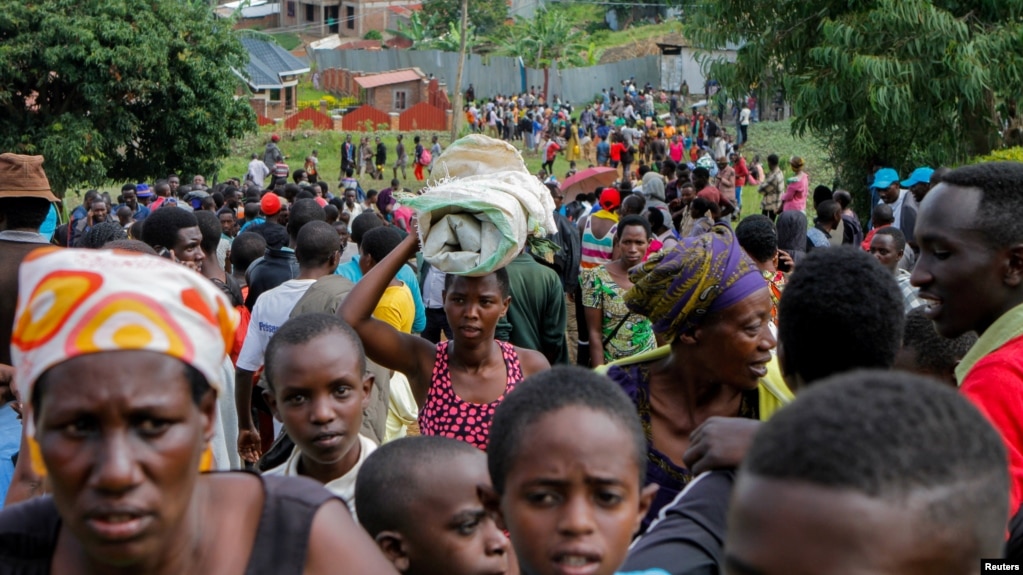

Five Ways To Help Refugees In Nashville

More information on what to do to help refugees in Nashville

This is default featured slide 5 title

Go to Blogger edit html and find these sentences.Now replace these sentences with your own descriptions.This theme is Bloggerized by NewBloggerThemes.com.

This is default featured slide 5 title

Go to Blogger edit html and find these sentences.Now replace these sentences with your own descriptions.This theme is Bloggerized by NewBloggerThemes.com.

Friday, February 10, 2017

Alleged French Police Rape of a Man Could Set the Country on Fire

CRUEL AND UNUSUAL

02.10.17 11:52 AM ET


PARIS—The young man's story is nothing short of horrific. 

Stopped by police during an identity check last week in Aulnay-sous-Bois, a gritty suburb on the edge of Paris, the 22-year-old allegedly was forced to the ground, beaten, and raped with a police baton.
"He took his baton and deliberately drove it into my butt," the man, identified as "Theo" in the French press told BFMTV on Monday from his hospital bed. "I fell on my stomach, I had no strength left."
Theo recalled struggling to walk as the officers dragged him to a nearby police car.
"I thought I was going to die," he said.
So severe were his injuries that the youth worker with no criminal record required emergency surgery and remains hospitalized. His sister told French media that the long-term effects of the assault are not yet known.
The case has shocked France, and demonstrators have since gathered in Paris, Nantes, and Rennes to denounce police brutality. Fears continue that any efforts by the police to cover up what happened—or that even seem to cover it up—could spark widespread rioting in the same areas that ignited violence all over France in the autumn of 2005.
Grainy footage of the altercation shows four officers standing over a young black man lying on the ground near a concrete wall. Two officers are then shown leading the man, who appears to be limping, to a squad car. Once inside the car, Theo said he was subjected to additional blows, as well as to racist insults.
All four officers were arrested following the incident. Rape charges have been filed against one cop, while the three others were slapped with assault charges. In a statement, Interior Minister Bruno Le Roux confirmed that all four had been suspended pending the investigation, saying that "exemplary conduct and respect must guide the behavior of security forces at all times." 
In a bid to quell rising outrage, French president Francois Hollande paid a visit to Theo in the hospital on Tuesday, praising the young man's "dignity and responsibility" in the face of his ordeal. Celebrities have also chimed in on Twitter, expressing anger and calling for justice. 
"Injustice anywhere is a threat to justice everywhere," French actor and comedian Omar Sy tweeted, quoting Martin Luther King Jr., while French actor Vincent Cassel called the incident "a national shame."
Despite the damning video evidence, cops deny Theo's claims, saying they had only been trying to get control of an unruly suspect. Frédéric Gabet, the lawyer for the officer facing rape charges, told BFMTV that the young man had violently resisted arrest, even arguing that the penetration with the baton was "accidental." 
"This action occurred in a very specific context during a skirmish with this boy, who is 6 feet 2 inches tall, and was struggling like the devil," said Gabet. "The police were using every method they could to bring him to the ground, including the baton. In these conditions a deliberate act doesn't align with the victim's statement."
"The police never pulled down his pants, his boxer shorts were pierced [by the baton]." he added.
Several of Theo's friends and family members have spoken out on his behalf, describing him as a gentle individual who works with young people and is well liked in the community.
GET THE BEAST IN YOUR INBOX!
By clicking "Subscribe," you agree to have read the Terms of Use and Privacy Policy
"When I hear [from the police version] that he hit a policeman, I don't believe it," a 27-year-old security guard who has known Theo's family since childhood, told AFP. "With others, you could imagine, but not him."
The president of the French chapter of SOS Racisme told The Daily Beast that given the amount of force necessary to cause the type of injuries Theo suffered, he had a difficult time believing that the assault was "completely accidental."
"Whether or not the injury he suffered was involuntary or not, Theo was a victim of unjustified police violence," said Dominique Sopo.
The brutality of the arrest  hit a nerve in Aulnay-sous-Bois and neighboring suburbs, In 2005 they were the scene of rioting that spread across the country after two young men were accidentally electrocuted while fleeing police. And for the past six nights youths have clashed with officers and set fire to cars and structures, first in Aulnay-sous-Bois, and later in the neighboring Seine Saint-Denis region, despite Theo's call for calm from his hospital bed.
In the riots that tore through the suburbs more than a decade ago, groups of angry young men torched vehicles and public building, prompting the country to declare a state of national emergency and bringing France's suburbs into the global spotlight.
Although they sit just north of Paris, the suburbs, banlieues in French, are worlds away from the glitz associated with the French capital. Rife with poverty, high unemployment, and grim concrete housing projects, their young residents (many the children of immigrants from North and West Africa) live in a bleak, insular world that is cut off from mainstream French society.
Those who do try to escape these depressed neighborhoods often face discrimination from job recruiters either on the basis of their ethnicity (headshots are obligatory on French resumes) or their address, which is often a dead giveaway as to an applicant's racial background or economic status.
As in impoverished corners of America, there is a climate of mistrust between young ethnic minorities living in the banlieues and police. Spontaneous "stop and searches" during which officers demand to see identity papers are routine, and while no official police brutality statistics exist in France, several troubling incidents have been documented in recent years.
In 2015, for instance, ++a neighbor filmed++ police officers repeatedly striking a woman in the Seine-Saint-Denis region after she reportedly tried to intervene in the violent arrest of her two teenage sons. And back in July,  24-year-old Adama Traoré died under mysterious circumstances while in police custody, setting off pockets of violent protests in the Val d’Oise region north of Paris.
Cops patrolling France’s banlieues have complained of unsafe working conditions, in which they are often targeted by gangs and drug dealers. In October, officers staged nationwide protests after a firebomb thrown at a police car left four cops injured in the suburb of Viry-Chatillon. 
Sopo said that in order to prevent brutal assaults like the one against Theo, police need to tackle issues of prejudice on a department-wide level.  Moreover, seasoned officers with past experience working in "sensitive" neighborhoods should be deployed to Paris's banlieues, instead of rookies who, according to Sopo, "confuse exercising authority with humiliation." 
Police interrogations and arrests also need an overhaul.
"Current arrest and detention techniques are extremely violent in France," said Sopo. "Enough is enough with police officers who think anything goes."
For the time being, all eyes will be on the outcome of the case. A guilty verdict could quell the resentment among residents who have longed believe that justice is not on their side. If the officers are exonerated, however, there are fears that the banlieues could burn once again.

Monday, February 6, 2017

Remembering the late Mathias Matemere

Public viewing1:00 p.m.-5:00 p.m
Friday, February 3, 2017
New Generation Funeral Home
2930 Murfreesboro Pike
Antioch, TN
Visitation with the Family10:00 a.m.-11:00 a.m.
Saturday, February 4, 2017
New Generation Funeral Home
2930 Murfreesboro Pike
Antioch, TN

Celebration of Life
11:00 a.m.
Saturday, February 4, 2017
New Generation Funeral Home
2930 Murfreesboro Pike
Antioch, TN

The Service of Committal & Interment
Calvary Cemetery
Nashville, TN
Mr. Mathias Matemere, age 89 of Franklin, transitioned from this earthly life to eternal life on Saturday, January 28, 2017, at Grace Healthcare of Franklin.

He leaves a host of devoted family members and friends to cherish his memories.


The completed obituary will be forthcoming.
Please keep the family of Mr. Mathias Matemere in your thoughts and prayers.

Sunday, January 29, 2017

All-In-For Matemere Cancer Fund

My name is Pierre Gasimbo and I am writing on behalf of my siblings and the rest of our family. Though our father is diabetic, he has been healthy overall. Without warning, he took ill two days before Christmas, on Dec 23rd. He has been hospitalized and diagnosed with Stage 4 cancer--Metastatic Squamous Cell Carcinoma. This devastating news has hit our family hard, as it was so sudden. Since being hospitalized, his body is deteriorating rapidly and he is losing much of his weight and strength. He continues to express constant agonizing pain.
The purpose of sharing this is, on behalf our family and siblings, to reach out to all friends and family, near or far, to provide my father the best care that we are able to as we face the possibility of him passing away. We are accepting what the doctors have told us, but we hold our truth that God can work miracles.
Accuracy on Hospice; Our Father was transferred from hospital to a nursing facility that has skill training and Physical therapy. At the time of hospital transfer he was not a qualified candidate for any hospice services but as his body continues to fail him as of January 10 he was discharged from physical therapy making him a candidate for hospice. Applications for hospice were turned on Wednesday, January 11th and can take up two months to get approval and family are taking proactive measures because during the waiting period the family is obligated to cover $250 per day for "room and board"  while his state insurance covers the medications. "Because room and board are not covered by Medicare, it cannot be treated as a “cross-over” item for partial payment by TennCare."  -Policy Office, Bureau of TennCare Section 3. Room and Board.
We would never think in a million years that we would have to use this website for ourselves. We have faith that, with the love of God, your prayers, and your helping hand we will overcome this battle. In the Bible Luke Chapter 12:48, it says: “For of those to whom much is given, much is required.”
A word on who our father is; our father Mathias(Matthew) Nzobonankira Matemere is a God fearing, hard working Christian man, full of life and respected by many. Raised in Kayanza, Burundi, he survived so much of the Burundi-Rwanda genocide turmoil and was forced to live in Tanzania refugee camps. In December 1998, he settled in Nashville, Tennessee. He is an amazing father, a grandfather, great grandfather and a community man. Our father has always worked to serve others and love everyone in his community. His sense of community spirit is what inspired him to serve as a city alderman. Today, he’s a well-respected community man, known to donate much his time to help resolve conflicts during his time as a mediator of many disputes within the local community. Despite everything that has tried to crush his spirit, he has continued to serve the community through his church in Nashville. Despite this sudden illness, if you are blessed to see him at his hospice bedside, you will see he remains strong and steadfast in his faith in God.
Friends, I know that times are tough right after Christmas. If you are able to lend us your support, whether by donating or sharing our story, it will provide our father with a fighting chance that can ease his suffering and allow him to be with his family during his darkest hour. We are eternally grateful for your compassion.
-Gasimbo on behalf of Mister Matemere and his family.

Tuesday, January 10, 2017

WJC Speech in Rwanda- 1998 - WikiLeaks - The Podesta Emails

Below is President Clinton's speech that he gave in Rwanda in 1998. ... First, let me thank you, Mr. President, and Vice President Kagame, and your wives for .... as you go about your business here, men and women who survived and go on, ... And believe me, after over 5 years of dealing with these problems, I know it is not ...

https://wikileaks.org/podesta-emails/emailid/8396

Tuesday, May 31, 2011

‘Peaceful’ Uganda is now a police besieged state

A military officer disperses supporters of opposition leader Kizza Besigye who had gathered to welcome him back to Kampala from Nairobi where he was seeking medical attention on May 12.
By Julius Barigaba, Special Correspondent


Posted  Sunday, May 29 2011 at 14:26

With armoured vehicles popularly known as Mamba sealing off the Constitution Square in the middle of the capital, the possibility of it creating a Ugandan version of Tahrir Square looks remote.
Tear gas and water canons have been parked around it for several months now, with policemen keeping vigil. But that might be a good thing. For all its resonance with Africa — and much of the Arab world — the Egyptian Tahrir is an aberration that is not going to happen every day, everywhere — least of all, in Uganda.  
Security is blocking access to Constitution Square, not to prevent a Tahrir, but to foil something worse — an Armageddon. Think Beijing’s Tiananmen Square, 1989.  
Tahrir collected a million anti-Mubarak protestors over three weeks, leading to the dictator’s fall in February this year. In Beijing, however, Tiananmen was the scene of a massacre by a military whose mindset is that of anarchy, akin to that of Uganda’s armed forces, according to political analyst Mwambutsya Ndebesa, professor of history at Makerere University.  
Led by students and intellectuals, the Tiananmen uprising, started on April 15, 1989. In four weeks, then Chinese premier Li Peng had declared martial law. On June 4, tanks and troops descended on the Square and slaughtered the protestors in their thousands. 
In Egypt, it was a pro-people army that could not shoot at the protestors. The same cannot be said of Uganda’s armed forces, going by number of casualties in one month of protests — so far nine shot dead, and some of them were not even rioting.  
Constitution Square touches the busy Kampala Road at the bottom, the High Court Building on the opposite side, hugging both the East African Development Bank building and Central Police Station on either side. 
Further down is Kampala’s busiest section of the CBD: Trade activity, matatus, human traffic, mobile salesmen, vendors perched on shop fronts, pickpockets, are all here. It is frightening to imagine what would happen if security were to let protestors into Constitution Square and open fire.  
The Square has become a no-go area, barricaded by blue Mamba APCs, tear gas trucks and anti-riot police. To dare to go there is to court arrest, unlimited doses of teargas, gunshot wounds, and possibly, death.  
On May 10, former presidential candidates Norbert Mao, Olara Otunnu, Sam Lubega and Mohammad Kibirige Mayanja attempted to access Constitution Square and stage a rally there. Somewhat Mao and Mayanja sneaked through the first line of police cordon but could not go past the next.  
“We want to hold a rally in the Square that is named after our (1995) Constitution. It is our right,” Mao yelled at the police as they pushed him back.  
But Otunnu, Lubega and others were not lucky. A police truck spewing pink liquid pushed them 200 metres away, bathing them in a deluge of crimson — police’s latest anti-riot innovation.  
That is the norm in Kampala these days — people wake up to a menu of live bullets and teargas. Access to some roads is blocked, as boda boda cyclists, unemployed youths and Kisekka Market traders engage the military and police in running battles. Occasionally, a military chopper eerily monitors the action. Files of military men, with guns held combat style, patrol the streets; APCs are at entry points into the city.  
How long before tanks come out?  
Police spokeswoman Judith Nabakoba denies that deployment of military, police and heavy weaponry at Constitution Square and other strategic points in the city is not to crush opposition protests.
“We have terrorism threats. This (deployment) should not be looked at as targeting only protestors and the opposition,” she told The EastAfrican.  
Fair enough, indeed Uganda is a terrorist target — the ghastly images of 7/11 twin bombings in Kampala still torment the survivors.  
Nonetheless, the manner of deployment still raises questions. The mambas and troops, for instance, are not only stationed at Constitution Square, Uganda’s equivalent of Tahrir, but they are a permanent feature at the Kibuye roundabout and several points along Entebbe Road, and Kalerwe roundabout on Gayaza Road.  
These roads lead to opposition leader Kizza Besigye’s work place and home respectively. Besigye is the face of resistance in the ongoing showdown between government and opposition.  
Besides this, in Masaka, Mukono, Luwero, Jinja, Mbale, Gulu and a few other towns in the north, the presence of the military is equally pronounced. These towns hold the highest concentration of anti-government sentiment. Towns in western Uganda — the stronghold of the ruling party — have no such deployment.  
Since the February 18 elections, opposition leaders have questioned the legitimacy of president Museveni’s 68 per cent win. They claim this “victory” is courtesy of two things: Money to buy votes, and an arsenal brought out onto the streets to intimidate voters.  
After arresting Besigye on April 11, police chief Kale Kayihura fluffed his lines big time but gave pointers why Constitution Square is restricted. He told journalists that the non-violent protests must be crushed. Yet he confessed that the police arrested the walking politicians but “quite frankly we did not know where they were going... along the way they wanted to find masses...they thought they would create a Tahrir Square somewhere in the city centre.”  
Thus Constitution Square is no longer ‘the people’s space’ where they can go to drown the misery of today’s economic hardships or to escape the depression caused by it.  
But lately, the Square gives a disconcerting sense of Tiananmen. You would think Kampala was a combat zone, or that the president has declared martial law. 
It’s a siege that will hurt Uganda’s economy, political sanity and rule of law, argues FDC Secretary for Security Major John Kazoora. 
“That’s what they want. Let’s remain a police, besieged state,” he said. “Let our children grow up in a culture of being surrounded by guns and mambas because that’s the culture we have built. In the end we are hurting ourselves and scaring away tourists and investors. Is that what we want for our country?  
Asked whether the uprising will climax in a mass demo at Constitution Square as claimed by security, he replies, “I am a founder member of A4C (Activists for Change); our campaign is about high prices, not to go to Constitution Square; why do they put words in our mouth?”  
Tour operators warned recently that Uganda will lose $100 million worth of tourism revenue monthly if the riots persist. But it is not tourists alone that are put off by the military hardware on display. In five months, Kampalans have seen more mambas than they have ever cared to.
“I am from the north but I had never seen so many mambas before,” says legislator Odonga Otto.
As the theatre of war for two decades, Northern Uganda endured this. Now the south, which enjoyed uninterrupted stability all this time, is being treated to real images of war, without actually being in one. It is the perfect irony of a country that is at peace. 
The see-saw events between opposition and government in the post February 18 election period pose some serious questions. Why does a man who was given such a bad beating at the polls attract so many crowds, some ready to die for him? What would happen if government let him get to Constitution Square? He scored only 26 per cent, after all. So, he would attract only a few thousand.

Not really. Besigye has built a magnetism that his tormentors cannot undo.  
The events of Thursday May 12, sum up as the spectacular climax of the tensions that had built up since the Walk-to-Work campaign started a month earlier to protest soaring fuel, food and commodity prices.  
It culminated into a clash of two forces — Besigye’s ‘army’ of boda boda cyclists and unemployed youth, armed with only twigs and their v-signs, overwhelming state police and military. Yes, some rode their motorcycles acrobatically enough to kill themselves, but they generally went about it peacefully, and the police were ready to take this humbling lesson, but not the military.  
“From the airport to Katabi, the crowds were non-violent because [Assistant Inspector General of Police, Francis] Rwego was in charge. Then the military took over and Rwego was annoyed because unprovoked, the military started beating and tear gassing people,” Maj Kazoora says.  
For his troubles, Rwego was suspended on May 17 and his sin is to have allowed a snail pace convoy. In the end, a 45-minute drive took nine hours with Besigye’s supporters and Museveni’s swearing-in entourage scrambling for space on the small Entebbe road.
Initially, the agreement was to allow three vehicles with police lead and escort cars in his convoy. But the numbers kept swelling, and police chose to accommodate them, provided that the crowds remained non-violent.
Diplomatic embarrassment  
Police and military descending on the crowds with live bullets, tear gas and chemicals was the ultimate diplomatic embarrassment, particularly when Besigye’s crowd responded by throwing stones at motorcades of presidents that attended Museveni’s inauguration. 
Angered by this episode, Museveni’s military might react in radical style. It is the best way to deal with an unrelenting opposition that has braved violence, but built up some momentum to resist since April 11. This might trigger a Tiananmen-like response.  
The increased presence of military hardware in the middle of the capital is twofold: To drive fear, and it is also a statement of intent, political actors argue.  
“We know the NRM intends to unleash the army in civilian clothes. This is a ploy that is so transparent we can see through it. We want to demystify the fear Museveni has instilled in the public; thereafter this campaign will evolve into a social movement,” says Otunnu.  
Yet there is more to come. In the next financial year, police has just put in a budget request for Ush29 billion ($12.4 million) for tear gas and anti-riot gear alone. And they need new supplies too, because some of the current stock of tear gas being used actually expired in 2004.  
So, will opposition foot soldiers cower from the mambas and tanks? Apparently not. Those that have not been shot dead (Human Rights Watch recently documented nine people, but that was before five other deaths reported in the May 12 fiasco), have been tear gassed and beaten, but they have marched on, buoyed by Besigye’s famous “you should not be intimidated” line. 
In a recent interview with the Monitor, IGP Kayihura stated that a police officer who escorted protestors to their place of work was ‘guilty’ while the one who used the butt of his gun to vandalise Besigye’s car, was hailed as ‘doing his job’. 
In short, when the order to unleash violence comes, the executing man will not waver. In the meantime, politicians and protestors can get close to Constitution Square if they are looking for a repeat of Tiananmen.


Rwanda officials would have to be really foolish to organise hyped UK murder plot

By Frederick Golooba-Mutebi  (email the author)

Posted  Sunday, May 29 2011 at 14:17

As the attention of East Africans was firmly fixed on Uganda’s perennially fractious politics and the latest battle of wills between President Yoweri Museveni and his tough-as-nails nemesis, Dr Kiiza Besigye, Britain’s Metropolitan police kicked up a storm that has engulfed the Government of Rwanda and the Foreign and Commonwealth Office over the past week or so.
Armed with “credible intelligence” from the FCO, the force had dispatched officers to go find two men. One is a Rwandan national in exile, the other, a UK national of Rwandan extraction. The officers went bearing grim news: The government of Rwanda was plotting against the two men and their lives were at risk.
If my memory serves me right, news bulletins suggested that the officers even insinuated that assassins might already be on the way to the UK to bump them off. And then they dropped another proverbial bombshell: the Met could not guarantee their security, so they had better be creative about how to do it themselves. They may even consider leaving their current addresses for some time.
As with all titillating stories, the media picked this up and ran off with it. And as with all bad, sensational, or ‘exciting’ news about Rwanda, it hit the newspapers, radio bulletins and TV broadcasts with a bang! I was half-listening to news on radio, half reading newspapers when I heard it on the BBC one early morning.
I was intrigued. It came in the wake of President Kagame’s robust and widely-publicised online exchange with a cocky British journalist who, while tweeting, had allowed himself to dispense wisdom on what is and is not good in and for Rwanda and Rwandans, without ever setting foot there.
New -media-savvy Kagame, not one to take lectures from self-appointed Rwanda experts, shot back, punch for punch and more, leaving the journalist taken aback. Surely that had come and gone, and couldn’t possibly be the background to the new story.
I then recalled that two political groups seeking to unseat the Rwanda Patriotic Front led government, Victoire Ingabire’s FDU-Inkingi, and Lt. General Faustin Kayumba Nyamwasa’s Rwanda National Congress, had recently held a meeting in the United Kingdom.
I wondered if the two were not connected. It seems they are, as one of the two men, one Jonathan Musonera, had been a key organiser of the meeting. He is also known to have got into a brief but heated exchange with President Kagame on the BBC’s Africa Have Your Say programme in the recent past.
It did not take long before it became the subject of intense online and verbal discussion among Rwandans and outsiders, some of whom have more than passing interest in the country.
Those prone to arriving at easy conclusions saw an immediate connection between this particular story and that of the attempted murder of Kayumba Nyamwasa in South Africa last year, which some firmly believe was the handiwork of “the Rwandans,” although the South African judiciary is yet to come up with a definitive verdict.
A friend with whom I discussed the issue believed Musonera had “made a mistake” by “arguing with Kagame” on radio. For him that was reason enough for the Rwanda government to invest energy and resources in a plot to kill him. It goes to show how lightly Kagame is taken by some of his critics.
Predictably, reactions from Rwandan officials and commentators on public affairs have been livid and dismissive of the story as “pure fiction” and “completely without foundation.”
And now the Rwanda government has challenged the metropolitan police to produce firm evidence of their claims and insisted on a retraction should they not have it.
How the Met responds to that will go a long way towards shedding light on a rather extraordinary story. Should the Met refuse to come clean, it will only strengthen the view that the FCO’s “credible intelligence” is based on a bogus story. Rwandans and Rwandaphiles wait with bated breath.
For me, though, the question is whether, given Britain’s well-established reputation in Rwanda as one of the country’s key donors and the RPF government’s important and trusted ally in an otherwise judgmental and easily hostile, “international community,” Rwandan officials would be so daft as to risk ruining the relationship by killing two dissidents living thousands of miles outside the country.

The North America Rwandan Community brings Rwanda Day to the City of Chicago.


The Diaspora will be honored by the presence of His Excellency the President of Rwanda Paul Kagame.

Banks, real-estate developers, insurance companies, employment agencies and many other organizations will be showcasing various products and services offered in Rwanda.

Blogger Themes

Popular Posts

© Rwandan Abroad Coalition. Powered by Blogger.

Followers

Recent Posts

Unordered List

Definition List